Building practical SAP capabilities through training, consulting and industry-focused expertise.
Aspiron Systems helps professionals build practical SAP skills and supports organizations with SAP training, consulting and implementation-focused expertise.
- Learners
- 4,000+
- Corporate Clients
- 125+
- Hiring Network
- 500+
- SAP ProfessionalsTrainers & Consultants
- 2,200+
- Placement Rate
- 85%
SAP Training and SAP Consulting, Under One Technology Ecosystem
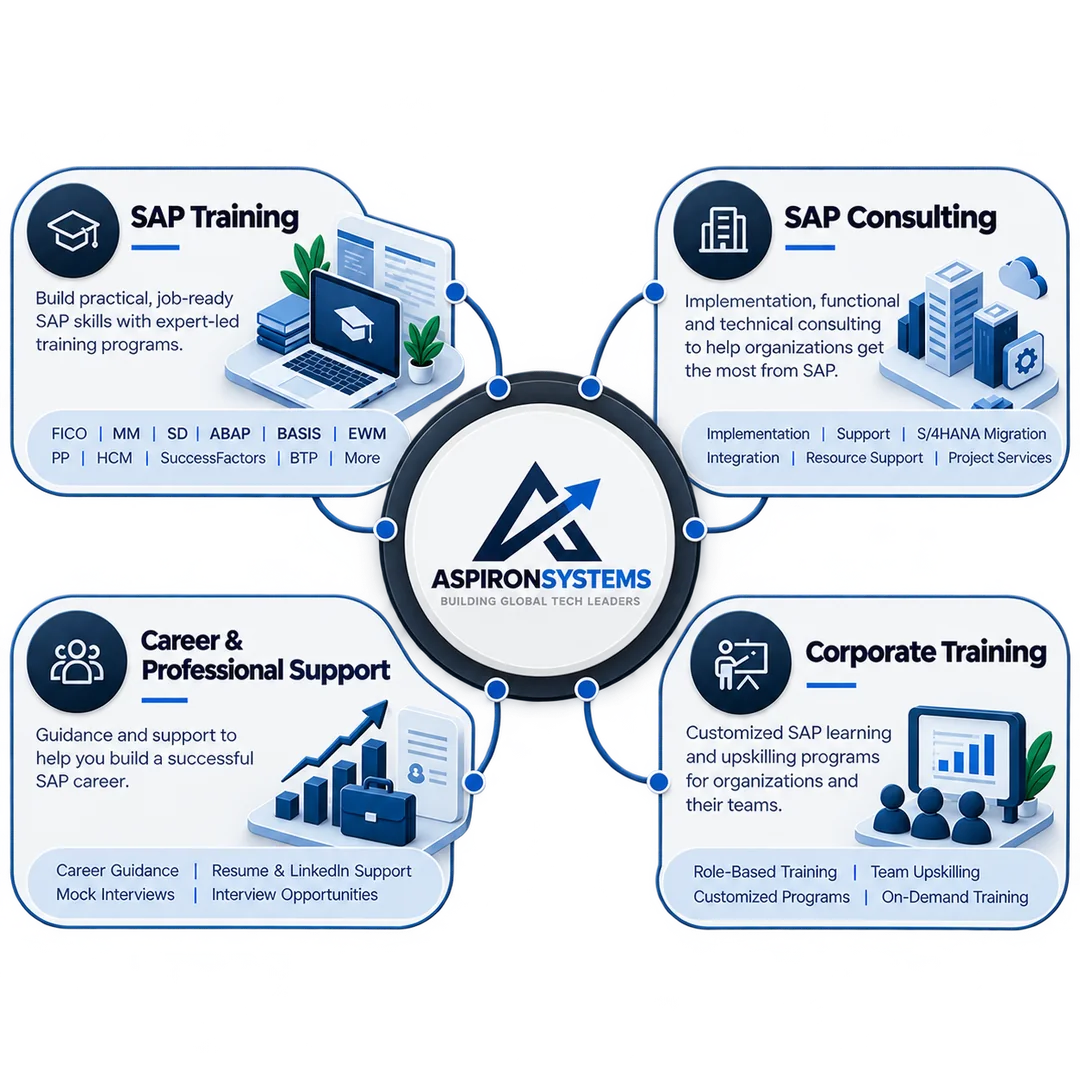
Aspiron Systems works across two connected areas of SAP expertise. We help professionals build practical SAP capabilities through structured training, while supporting organizations with SAP consulting and implementation-focused expertise.
SAP Training
Build skills. Prepare for opportunities.
Structured SAP training for fresh graduates, career switchers, working professionals and SAP professionals looking to strengthen their expertise.
- Live instructor-led training
- SAP system access for practical learning
- Implementation-oriented scenarios
- Certification preparation
- Career and interview support
SAP Consulting
Support businesses with SAP expertise.
SAP consulting services designed to support organizations across implementation, functional requirements, system support and SAP-driven business processes.
- SAP implementation support
- Functional consulting
- SAP process understanding
- Project and support services
- Enterprise SAP expertise
Training builds SAP capability. Consulting applies it.
SAP Training for Individuals and Corporate Teams
Our SAP training runs in two formats: programs that individuals join to build their own SAP career, and customized training that organizations arrange for their teams.
For individuals
SAP Training for Individuals
Live, instructor-led SAP programs for people building or advancing their own SAP career.
Who it is for
Fresh graduates, career switchers, working professionals and SAP professionals strengthening their expertise.
How it runs
Live instructor-led sessions with SAP system access and implementation-oriented scenarios.
What it includes
SAP certification preparation, resume building, LinkedIn profile optimization, interview preparation, mock interviews with expert feedback and relevant interview opportunities based on the candidate’s eligibility and profile suitability.
For corporates
SAP Corporate Training
Customized SAP training for organizations that need their teams ready for SAP projects.
Who it is for
Existing employees moving to new SAP skills, new hires and campus recruits, and project teams.
How it runs
Virtual instructor-led sessions, on-premise training at your office in select locations, or a hybrid of both.
What it includes
A curriculum tailored to your industry and project requirements, with hands-on SAP system practice.
Build Skills Across the SAP Ecosystem
Explore SAP training across functional, technical and emerging SAP technology areas. Our programs cover a wider range of SAP roles and technologies, with program availability based on the current training schedule and learner requirements.
SAP Functional
SAP Technical
SAP ABAPABAP on HANASAP BASISSAP BTPBTP RAPBTP CAPBTP AdministrationSAP GRCSAP AnalyticsSAP Integration
Live TrainingPractical System AccessImplementation ScenariosCertification PreparationCareer Support
From SAP Learning to Professional Readiness
A structured approach that connects SAP knowledge, practical exposure and career preparation.
Choose Your Path
Identify the SAP area that fits your background and career direction.
Build SAP Knowledge
Learn through structured, instructor-led training focused on relevant SAP concepts and processes.
Practice in SAP
Apply what you learn through SAP system access, practical activities and implementation-oriented scenarios.
Professional Readiness
Strengthen your CV, LinkedIn profile, communication and SAP interview readiness.
Explore Opportunities
Eligible candidates receive relevant interview opportunities based on their skills, eligibility and employer requirements.
Grow Through Experience
Continue developing your SAP capabilities as you progress into professional opportunities and enterprise technology environments.
Structured TrainingPractical System ExposureCareer PreparationRelevant Opportunities
A SAP Ecosystem Built Around Practical Capability
Aspiron Systems brings training, consulting and professional SAP expertise together to create a more connected learning and technology environment.
More than training. A technology ecosystem.
Our approach connects structured learning with practical SAP exposure, experienced professionals and an understanding of how SAP is used within enterprise environments.
01
SAP Training + Consulting
Training and consulting operate within the same Aspiron Systems ecosystem, creating a closer connection between learning and enterprise SAP requirements.
02
Practical SAP Exposure
Programs include system access, implementation-oriented scenarios and project-focused learning to help candidates develop practical familiarity with SAP.
03
Experienced SAP Professionals
Our professional network includes SAP consultants and trainers who contribute to training programs based on program requirements and availability.
04
Career-Focused Support
Candidates can access support across professional profiles, interview preparation, mock interviews and relevant career opportunities based on eligibility.
We bring learning, practical exposure and enterprise SAP expertise together so candidates can understand not only what SAP is, but how it is applied.
Learn SAP With More Than Just Classroom Concepts
Our training approach combines structured instruction with SAP system access, implementation-oriented scenarios and project-focused learning to help candidates develop practical familiarity with SAP environments.
Understand how SAP processes work
Build a clear understanding of SAP processes, their purpose and how different functions connect within an enterprise environment.
Work with the SAP system
Work with SAP system access to understand processes through actual system-based practice rather than relying only on theoretical concepts.
Connect concepts to practical situations
Connect functional concepts with implementation-oriented scenarios and understand how SAP processes are applied in practical situations.
Bring learning together through projects
Bring the learning together through project-oriented activities designed to help candidates understand how SAP knowledge is applied across a broader process.
From understanding the process to working with the system, the focus is on developing practical familiarity that candidates can carry into SAP interviews and professional environments.
Supporting Organizations With SAP Expertise
Aspiron Systems also works with organizations on SAP consulting and implementation-focused requirements, bringing functional knowledge, SAP process understanding and enterprise technology expertise together.
SAP Implementation Support
Support organizations across relevant SAP implementation activities and process requirements.
Functional Consulting
Bring SAP functional understanding to business processes, requirements and solution discussions.
SAP Process Understanding
Connect business requirements with SAP processes and help organizations work toward practical solutions.
Project & Support Services
Support project and ongoing SAP requirements based on the scope, technology and expertise required.
Business RequirementsSAP ProcessesImplementationSupport
Consulting engagements are shaped around the organization's requirements, project scope and the SAP expertise needed.
Where SAP Training Meets Enterprise Experience
Training and consulting are connected within Aspiron Systems. This helps us keep professional learning closer to the processes, requirements and working environments that shape SAP projects.
01
SAP Training
Professionals build SAP knowledge through structured instruction, practical system access and implementation-oriented learning.
Explore SAP Training02
SAP Consulting
Organizations receive SAP expertise aligned with business processes, project requirements and implementation or support needs.
Learning informs expertise. Enterprise requirements keep learning relevant.
The two areas serve different audiences, but share a common foundation in SAP technology, processes and professional expertise.
Support That Continues Beyond SAP Training
Building SAP knowledge is one part of the journey. Aspiron Systems also supports eligible candidates with professional profile preparation, interview readiness and access to relevant career opportunities.
01
Build Your Professional Profile
Develop a professional CV and LinkedIn profile aligned with your SAP skills, experience and career direction.
02
Prepare for SAP Interviews
Understand the types of questions, discussions and practical topics that can arise during SAP interview processes.
03
Practice Through Mock Interviews
Use mock interview sessions and expert feedback to identify areas that need further preparation before applying.
04
Explore Relevant Opportunities
Eligible candidates can receive relevant interview opportunities based on their skills, eligibility and employer requirements.
Career support does not replace the employer selection process.
Interview opportunities and employment outcomes depend on candidate skills, eligibility, role requirements and the selection process of the relevant organization.
Learn With Access to SAP Professionals
Aspiron Systems works with a professional network of SAP consultants and trainers who bring experience from different SAP functions and enterprise technology environments.
2,200+Professionals
SAP Consultants & Trainers
Our professional ecosystem supports both training and consulting activities. Training assignments are aligned with program requirements, consultant expertise and availability.
01
Consultant-Led Learning
Training can draw on practical experience from professionals working across SAP environments.
02
Professional Expertise
Access to professionals across different SAP functions helps support varied program requirements.
03
10–30 Years of SAP Experience
Our trainers bring 10–30 years of experience across the SAP ecosystem, with exposure to multiple implementation and support projects. Their experience helps candidates understand how SAP is applied in real business environments, connecting classroom concepts with practical project situations rather than learning through theory alone.
04
Connected SAP Ecosystem
The network connects training, consulting and broader enterprise SAP expertise within one ecosystem.
Training connected to professional SAP expertise.
Trainer availability and professional involvement can vary by program, training format and specific requirements.
Connecting Eligible Candidates With Relevant Opportunities
Aspiron Systems supports eligible candidates beyond training by connecting them with relevant interview opportunities through its wider hiring network, based on skills, eligibility and employer requirements.
500+Hiring Network
A wider network of organizations and recruitment relationships that can support relevant interview opportunities for eligible candidates.
- 01
Complete Your Training
Build the SAP knowledge and practical familiarity required for relevant roles.
- 02
Prepare Your Profile
Strengthen your CV, LinkedIn profile and interview readiness with career support.
- 03
Receive Relevant Opportunities
Eligible candidates will receive relevant interview opportunities based on their skills, eligibility and employer requirements.
- 04
Go Through the Employer Process
Final interview selection and employment remain subject to the requirements and selection process of the relevant organization.
TrainingProfile PreparationRelevant Interview OpportunitiesEmployer Selection
The hiring network supports access to opportunities. It does not represent a guarantee of interview selection or employment.
Organizations Across Our Hiring Ecosystem






























Testimonials
Real WhatsApp messages from candidates who trained with Aspiron Systems. Select one to read the full chat.
Answers to Questions SAP Candidates Ask
Not every question needs a full blog article. These are some of the practical questions and doubts candidates commonly have while exploring SAP as a career. Select a topic to read the complete answer.
A simple explanation of SAP, what businesses use it for and why SAP professionals work across different functional and technical areas.
SAP is a technology company and SAP is also commonly used to refer to the enterprise software systems built by SAP. Businesses use SAP software to manage and connect important business processes across areas such as finance, procurement, sales, manufacturing, supply chain and human resources.
Instead of keeping every business function in completely separate systems, an SAP environment can connect processes and information across an organization. This is one reason SAP has such a wide range of functional and technical career paths.
What does an SAP professional actually work with?
It depends on the area of specialization. A functional professional may work with business processes such as finance, materials management or sales. A technical professional may work with development, databases, integrations, administration or SAP platform technologies.
Why are there so many SAP modules?
Large organizations have many different business processes. SAP therefore provides different applications and capabilities for different business functions and technology requirements.
For someone considering an SAP career, the first step is usually understanding which business or technology area matches their background and career direction rather than trying to learn everything in SAP at once.
A straightforward explanation of SAP HANA, why it is important in modern SAP environments and how candidates should understand it.
SAP HANA is a database and data platform developed by SAP. It is designed to process large volumes of data efficiently and supports transactional and analytical workloads.
One of the important characteristics associated with SAP HANA is its in-memory approach, where data can be processed in memory to support fast data access and processing. HANA also provides capabilities for data modeling, analytics and application development.
Why does HANA matter to SAP professionals?
HANA became an important foundation for SAP's modern application landscape. Understanding the database helps candidates understand the technology underneath many SAP solutions and why modern SAP environments are structured differently from older landscapes.
Is HANA only for SAP S/4HANA?
No. SAP HANA is a database and data platform in its own right. SAP S/4HANA is an enterprise application suite designed to run on SAP HANA.
This distinction is important because HANA and S/4HANA refer to different things, even though they are closely connected in modern SAP environments.
One of the most common beginner doubts explained simply: HANA is the database platform, while S/4HANA is the ERP application built to run on it.
The simplest way to understand the difference is to separate the database from the business application.
SAP HANA is the database and data platform. It provides the underlying technology for storing and processing data.
SAP S/4HANA is SAP's modern enterprise resource planning application suite. It uses SAP HANA as its underlying database platform and provides business processes and applications for organizations.
A simple way to remember it
Think of HANA as the technology platform underneath, while S/4HANA is the business application running on that platform.
Why does this matter for candidates?
Many SAP job descriptions mention S/4HANA, while technical discussions may mention HANA. Knowing the distinction helps candidates understand whether a discussion is about the database technology or the enterprise application.
For functional candidates, learning S/4HANA usually means understanding business processes in the modern SAP ERP environment. Technical candidates may need deeper knowledge of HANA, development, administration, data modeling or related platform technologies depending on their role.
A common question from graduates: whether previous SAP experience is required and what a fresher should focus on before applying for SAP roles.
Fresh graduates can explore SAP as a career path. The starting point depends on their educational background, area of interest, learning effort and the requirements of the roles they apply for.
What should a fresher focus on?
A fresher should first choose a relevant SAP area instead of trying to learn multiple modules at the same time. Building process understanding, SAP system familiarity and the ability to explain what they have learned are useful foundations.
Is certification enough?
Certification can demonstrate structured study, but it does not by itself demonstrate practical project experience or guarantee employment. Candidates should also build system familiarity, understand business scenarios and prepare for interviews.
What about experience requirements?
Employers set their own requirements. Some opportunities are designed for entry-level candidates, while others require prior professional or SAP experience. Candidates should therefore read each job description carefully and prepare according to the role.
A practical answer for professionals from finance, commerce, operations and other backgrounds considering a transition into SAP.
Yes, professionals from non-IT backgrounds can explore SAP, particularly in functional areas where previous business or domain knowledge can be relevant.
Does your previous background matter?
It can. For example, someone with finance or accounting experience may find SAP Finance concepts more familiar, while someone with procurement or supply-chain experience may already understand business processes related to SAP procurement and logistics.
What needs to be learned?
The professional still needs to learn SAP terminology, system processes, relevant configuration concepts and how business requirements are handled in an SAP environment.
The transition is therefore not simply about adding an SAP certificate to an existing resume. Candidates need to build enough SAP understanding to explain and apply their knowledge in relevant professional situations.
A common starting-point doubt for candidates deciding between SAP FICO, MM, SD, technical and other SAP career paths.
Choosing an SAP module is easier when you start with your background and the type of work you want to do rather than choosing a module only because it is popular.
Start with your existing knowledge
Finance and accounting backgrounds can provide useful context for SAP Finance. Procurement, operations and supply-chain experience may provide useful context for materials and related processes. Sales experience can be relevant to sales and distribution processes.
Consider functional versus technical work
Functional roles generally focus more on business processes and how SAP supports them. Technical roles can involve development, databases, administration, integrations and platform technologies.
Look at the actual job requirements
Before choosing a program, review current job descriptions for the type of role you want to pursue. This can help you understand the skills, experience and SAP knowledge employers commonly request.
A good module choice should therefore make sense for your background, interests and intended career direction, not simply for its name or popularity.
A realistic explanation of what certification can demonstrate and why candidates are also asked about practical knowledge during interviews.
SAP certification can demonstrate that a candidate has prepared for a defined certification curriculum and understands the topics covered by that certification. It should not be treated as a guarantee of employment.
What else do employers look for?
Requirements vary by role, but employers can consider SAP knowledge, domain understanding, practical exposure, communication, problem solving and previous experience.
Why does practical learning matter?
Interview questions may ask candidates to explain business scenarios, process flows or how a requirement would be approached in an SAP environment. Practical exposure can help candidates discuss these situations more clearly.
Certification and practical preparation therefore serve different purposes. Candidates should understand both before applying for SAP roles.
An important interview question for beginners: the difference between training exposure, project practice and professional project experience.
Candidates should clearly distinguish between training exposure, project-oriented practice and professional project experience.
Training exposure
This can include learning SAP concepts, following demonstrations, practicing transactions and working through guided exercises.
Project-oriented practice
A structured training project can help candidates understand requirements, processes, system activities and implementation scenarios in a controlled learning environment.
Professional project experience
Professional experience refers to work performed as part of an actual organization or client engagement, subject to the responsibilities and role held by the individual.
Being precise about this distinction is important during interviews. Candidates should describe their actual experience accurately rather than presenting training practice as client project employment.
Quick answers for candidates. Deeper topics belong in our blog.
Explore the SAP Blog Ready to Explore Your SAP Career or Business Requirement?
Speak with the Aspiron Systems team to understand the right SAP training program, career support or consulting approach based on your requirement.
SAP TrainingSAP Consulting
Tell us what you are looking for.
Our team can help you understand the next step before you make a decision.